

In March 2020, Arnold Rosenblatt removed his trustee. She borrowed $200,000 against a building his trust owned and used the money to hire lawyers to stop him. She admitted it in her own court filing, and a Los Angeles Superior Court judge wrote it into the record.
She held the money. He wanted control of it back. So she spent his money fighting him for it, and every month the fight went on, she decided how much of his money to spend. That is what “entrenches” means. It is a funding advantage, and the trustee starts with it.
Trust disputes don’t start in a courtroom. They start with a phone call that goes unreturned, a distribution that never arrives, or an amendment signed weeks before a parent’s death. California trust litigation exists to correct exactly this. The Daily Jones and Company’s fiduciary abuse and trust litigation practice handles complex trust disputes across California and internationally. Contact the firm for a free consultation.

What Trust Litigation Actually Involves
Trust litigation is court intervention to resolve disputes arising from how a trust was created, amended, or administered. Under California Probate Code § 17200, the probate division of the Superior Court has jurisdiction over the internal affairs of trusts — petitions to compel accountings, remove trustees, interpret ambiguous terms, enforce distributions, and adjudicate validity disputes.
In practice, a serious trust case is rarely one claim. Mr. Rosenblatt’s cross-petition carried seven: recovery under § 850, breach of fiduciary duty, financial elder abuse, civil theft under Pen. Code § 496(c), breach of trust, a constructive trust, and an accounting order. The same conduct usually violates several statutes at once.
Trust Contests vs. Trustee Lawsuits
A trust contest challenges the validity of the trust document or a specific amendment. A trustee lawsuit assumes the trust is valid and challenges how it is being administered. In Rosenblatt, the former fiduciary petitioned to uphold a 2014 amendment that named her successor trustee and beneficiary. He cross-petitioned on how she had run the trust. Both were tried together, because the amendment was the only thing authorizing what she had already done.
Common Reasons Trust Litigation Arises
The most frequent triggers include trustees refusing distributions, missing accountings, self-dealing transactions, suspicious late-life amendments, undue influence or capacity allegations, and misappropriation of trust assets. Many cases also involve elder financial exploitation — the National Center on Elder Abuse and California Attorney General’s elder abuse resources both identify late-in-life amendments made under caregiver influence as a primary pattern.
One trigger belongs on every list and rarely makes it: the beneficiary cannot see the accounts. In Rosenblatt, the trust’s brokerage accounts were opened in October 2013 titled to the trustee. The settlor had no access and received no statements for roughly seven years. Self-dealing is easy when nobody can see the ledger.
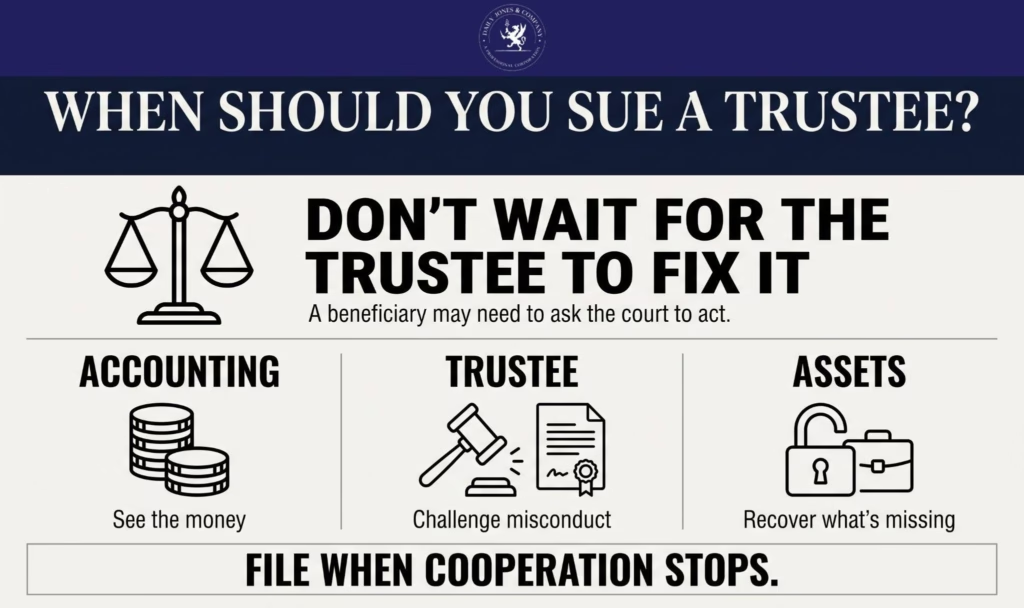
What Trustees Are Legally Required to Do
The American College of Trust and Estate Counsel calls trustee fiduciary duty one of the most demanding standards in private law. Trustees must keep beneficiaries informed under § 16060, provide formal accountings under § 16062, manage assets as a prudent investor would, and avoid any self-interested transaction. Violations are actionable under § 16400 whether intentional or negligent.
The duty to inform is broader than the statute alone suggests. A trustee has a common-law duty to disclose fully all material facts (Van de Kamp v. Bank of America (1988) 204 Cal.App.3d 819, 835) and must furnish each beneficiary all information necessary to protect their interests (Werschkull v. United Cal. Bank (1978) 85 Cal.App.3d 981, 1001). Silence is a breach.
The Rule That Changes These Cases: The Burden Flips
Under Probate Code § 16004, when a trustee obtains an advantage from a transaction with a beneficiary during the trust, that transaction is presumed to breach fiduciary duty — the trustee must prove it was fair (Buchmayer v. Buchmayer (1945) 68 Cal.App.2d 462, 467). Where a trustee dealt with trust property in an individual capacity, courts “will not permit any investigation into the fairness of a transaction” at all (In re Boggs’ Estate (1942) 19 Cal.2d 324, 333).
A gift an attorney-in-fact makes to himself outside the scope of the power is void even under the principal’s express oral direction (Estate of Huston (1997) 51 Cal.App.4th 1721, 1727). “He told me I could have it” is not the end of the argument.
Beneficiary Rights and What an Accounting Actually Does
Under § 17200, a beneficiary can petition to compel accountings, enforce distributions, remove a trustee under § 15642, and recover wrongfully transferred assets under § 850. The law hands you the tools. It does not use them for you.
In Rosenblatt, the court-ordered accounting arrived July 1, 2021. Her accounting reported $471,823.21 in donations to her nonprofit. Her later petition reported $384,944. Her own CPA testified the tax filings showed roughly $125,000. Three numbers, one set of books. The court’s response to the $746,147.78 gift claim: “no independent testimony nor any documents to verify this claim of a substantial gift.” The document did it.
How Trust Litigation Proceeds
A California trust dispute begins with a petition in the probate division of the Superior Court. Discovery follows — subpoenas, depositions, and expert witnesses. In Rosenblatt, the court credited a geriatric psychiatrist whose testimony “withstood vigorous cross-examination” and discounted the opposing expert who “exceeded the bounds of an expert witness and became an advocate.” Experts do not cancel each other out. Many disputes resolve at mediation before any hearing.
The Rosenblatt matter opened May 12, 2020. Judgment entered December 30, 2024. The accounting order came in 2021 — the document that won the case existed three years before the case ended. Early petitions lock the other side into numbers before anyone knows which ones will matter. California has not adopted the Uniform Trust Code in full, so California-specific rules apply throughout.
What Remedies Courts Can Order
California probate courts can order trustee removal, compelled accountings, surcharge under § 16420, asset recovery under § 850, constructive trusts, distribution orders, injunctions, double damages under § 859, treble damages under Penal Code § 496(c), and mandatory attorney’s fees. In Rosenblatt:
| Kaplan | Voice for the Animals | |
| Compensatory damages | $1,792,756.06 | $917,023.21 |
| § 859 double damages | $3,585,512.12 | $1,834,046.42 |
| § 496(c) treble damages | $5,378,268.18 | $2,751,069.63 |
| Attorney’s fees | $4,375,592.04 | $2,200,855.70 |
| Subtotal | $15,132,128.40 | $7,702,994.95 |
Plus $76,636 in costs — $22,911,759.35 total. The court ordered title to the house transferred back to the trust free and clear and expunged the lis pendens on the settlor’s home. It found the trustee guilty of “oppression, fraud, and malice” but awarded no punitive damages because the record lacked proof of her net worth. You get what you prove.
The Attorneys Who Handle These Cases
James D. Daily, Esq.
James Daily has spent more than 30 years litigating complex trust disputes, fiduciary abuse claims, and asset recovery matters across California and internationally. He tried the Rosenblatt matter to judgment and argued the Penal Code § 496(c) claim that produced the treble damages award.
Michael Jones, Esq.
Michael Jones specializes in fraud, theft, and breach of fiduciary duty, with a decade of experience in state and federal courts. He was co-counsel of record in the Rosenblatt trial. His background includes working alongside the FBI, U.S. Marshals, and district attorney offices. At Daily Jones and Company, he handles trust litigation, inner-familial disputes, and fiduciary abuse claims with a results-driven approach.
Alexandra Jarvis, Esq.
Alexandra Jarvis is a trial attorney combining fiduciary litigation with sophisticated real estate experience. Before joining Daily Jones and Company, she practiced business litigation at Call and Jensen and represented luxury real estate clients across Orange County. Her focus includes trust contests, undue influence, financial elder abuse, and complex real estate disputes. She earned her J.D., with distinction, from UC Irvine School of Law and has been admitted to practice in California since 2019.
Contact The Daily Jones and Company
Nobody is going to hand you an accounting because it is the right thing to do. Arnold Rosenblatt did not get his because he asked nicely. He got it because a judge ordered it, and the judge ordered it because somebody filed. That is the only part of this you actually control.
The Daily Jones and Company handles the full range of California trust litigation, from compelled accountings and trustee removal to contested amendments and international asset recovery. Contact the firm for a free consultation.
Frequently Asked Questions
What does California Probate Code § 17200 do?
Section 17200 gives California probate courts jurisdiction over the internal affairs of trusts, letting interested parties petition to compel accountings, remove trustees, interpret ambiguous language, enforce distributions, and resolve validity disputes.
Can a beneficiary sue a trustee personally?
Yes. Under § 16420, courts can order personal restoration of misappropriated assets, damages, and in bad-faith cases, the prevailing party’s attorney’s fees.
What happens if the trustee uses trust money to fight me?
In Rosenblatt, the trustee borrowed $200,000 against trust real estate and spent it to stop the settlor from removing her. The court called it self-dealing, counted every dollar in the damages calculation, and the statutes multiplied it. Raise it early — the spending itself becomes evidence.
Do I have to prove a self-dealing transaction was unfair?
No. Under § 16004, when a trustee obtains an advantage from a transaction with a beneficiary during the trust, the transaction is presumed to breach fiduciary duty. The trustee must prove it was fair (Buchmayer v. Buchmayer (1945) 68 Cal.App.2d 462, 467).
The trustee says my parent gave them the money. Does that end the case?
No. A gift an attorney-in-fact makes to himself outside the scope of the power is void even under the principal’s express oral direction (Estate of Huston (1997) 51 Cal.App.4th 1721, 1727). In Rosenblatt, the $746,147.78 gift claim failed because there was “no independent testimony nor any documents to verify” it.
Can trust litigation involve elder financial abuse claims?
Yes, and consequentially. Elder abuse statutes carry double damages under § 859 and treble damages under Penal Code § 496(c). In Rosenblatt, those turned $2.7 million in compensatory damages into a judgment exceeding $22.9 million.
Can a trustee be removed before a case goes to trial?
Yes. Under § 15642, courts can remove a trustee at any stage on sufficient evidence of breach or risk to assets. Emergency petitions can freeze distributions immediately.
What evidence is most useful in a California trust dispute?
Trust documents, accountings, bank statements, wire records, and communications are foundational. Loan applications are underused — people tell lenders things they will not tell a court. Inconsistencies across the trustee’s own filings can be worth more than any expert: in Rosenblatt, three different numbers for the same transfers across an accounting, a later petition, and a tax return did more damage than any witness.