

You were named in the will. You watched a parent spend a lifetime building something. And now an executor who won’t return calls, a sibling who moved assets before the funeral, or a caregiver who rewrote the estate plan is standing between you and what was meant to be yours.
Orange County’s concentration of high-value real estate, family businesses, and multigenerational wealth means these disputes surface regularly. The Daily Jones and Company is based at 660 Newport Center Drive in Newport Beach, minutes from the Orange County Superior Court Probate Division. Contact the firm for a free consultation.
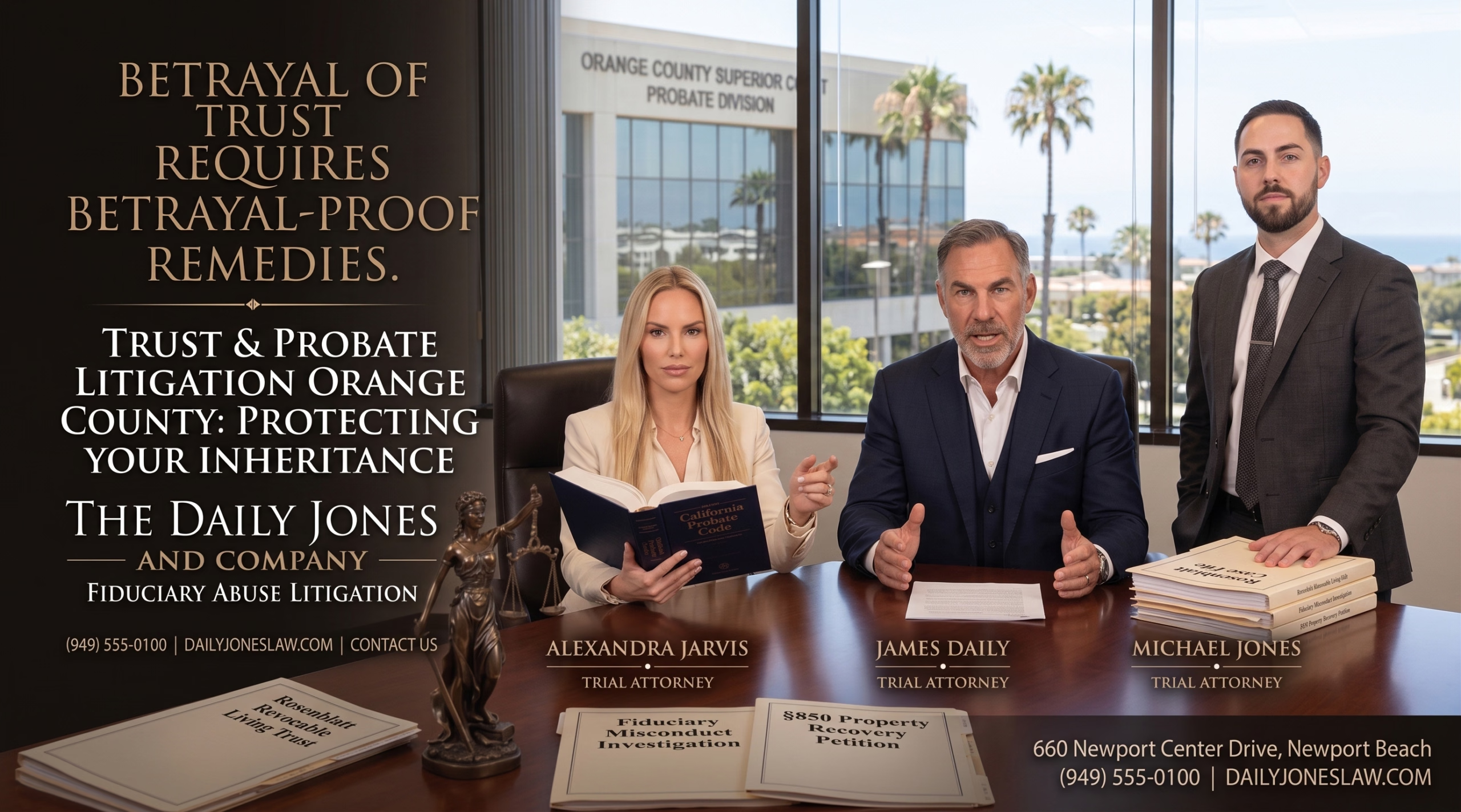
What Probate Litigation Actually Covers
Most estates move through probate without a dispute. Probate litigation arises when that cooperative process breaks down: a will whose validity is in question, a fiduciary acting in bad faith, assets that cannot be accounted for, or a beneficiary whose rights are being ignored.
| Routine Probate | Probate Litigation | |
| Nature | Court-supervised administration | Active legal dispute |
| Contested | Usually no | Yes |
| Who resolves it | Executor administers | Judge decides |
| Focus | Orderly distribution | Rights and accountability |
Beneficiaries routinely read early misconduct as an administrative delay. Nothing about an estate improves on its own while you wait to see what happens.
When You Need a Probate Litigation Lawyer
You may need counsel when: someone is challenging the validity of a will; an executor refuses to provide an accounting; estate property appears to have disappeared or been transferred; you suspect undue influence or financial elder abuse; a fiduciary is benefiting personally from estate property; or beneficiaries disagree over major assets.
Not every disagreement requires a full contest. A petition for instructions, asking the court to resolve how an ambiguous provision should be read, is often faster and cheaper than challenging a document’s validity outright.
Why Orange County Produces Complex Probate Disputes
Blended families pit children from a prior marriage against a surviving spouse. Closely held businesses are difficult to value and divide fairly. Vacation properties in disputed ownership structures generate title conflicts. As the California Attorney General’s elder abuse resources document, financial exploitation surfaces consistently in probate disputes, particularly when a new will or trust amendment appears shortly before death following a period of isolation.
Most of what the firm sees fits one of three shapes: a late-arriving caregiver who displaces the natural family, a fiduciary who becomes the problem rather than the protector, or siblings turning on each other over unequal treatment. Naming which pattern a case fits early shapes what evidence to go get first.
Common Probate Litigation Matters in Orange County
Will Contests
California Probate Code § 8270 generally requires a contest within 120 days after a will is admitted to probate. Grounds include lack of testamentary capacity, undue influence, fraud, forgery, duress, and improper execution. A no-contest clause doesn’t automatically end the fight: Probate Code § 21311 sharply limits when those clauses are enforced against a contestant.
Executor Misconduct and Removal
One pattern appears in nearly every serious misconduct matter: the fiduciary paying personal legal fees out of estate funds. In the firm’s Rosenblatt matter, a fiduciary borrowed $200,000 against property she was supposed to protect and spent it on lawyers to stop the owner from removing her. The court called it self-dealing and counted every dollar against her.
Trust Disputes and Trustee Removal
Under Probate Code § 15642, courts can remove a trustee for breach of fiduciary duty or conduct that threatens trust assets. Under Probate Code § 17200, beneficiaries can petition to compel accountings, enforce distributions, and recover misappropriated assets. A trust dispute is often two claims stacked together: a validity challenge to an amendment and a separate breach-of-duty claim against whoever is administering it.
Removal isn’t always the goal; a compelled accounting or surcharge can recover the loss faster when the administration is salvageable. When trust property is at risk, the Orange County probate bench will calendar a genuine emergency promptly, but expects the supporting record filed with the petition itself.
Recovery of Estate Property
Probate Code § 850 lets an interested party petition for recovery of property wrongfully transferred or concealed before or after death. Families underuse it because they assume the money is gone. It usually is not. In Rosenblatt, a § 850 petition recovered title to a house purchased with $746,147.78 in trust funds, expunged a fraudulent lis pendens on the elderly owner’s home of thirty years, and contributed to a judgment exceeding $22.9 million.
Elder Financial Abuse in Probate Disputes
Estate disputes involving financial abuse can implicate enhanced remedies under Probate Code § 859 and, in qualifying cases, Penal Code § 496(c). In Rosenblatt, those multipliers turned $2.7 million in compensatory damages into a judgment of $22,911,759.35.
The Orange County Probate Court
All probate litigation in Orange County is heard in the probate division at the Costa Mesa Justice Complex, 3390 Harbor Blvd., Costa Mesa. Examiner notes and case scheduling are managed through the court’s online portal.
Cases begin with a petition setting out standing, the relief sought, and the legal basis for the claim. Discovery follows, then in most cases mediation before any hearing. Cases that proceed are decided by a probate judge, not a jury.
Warning Signs That Warrant Legal Action Now
Probate misconduct almost never arrives as an admission. It arrives as a pattern: distributions delayed without explanation; refusal to provide inventories or accountings; estate assets sold below market to connected parties; a fiduciary paying personal legal fees from estate funds; one beneficiary receiving preferential treatment; or no access to assets you’re a beneficiary of.
The last item deserves attention. In Rosenblatt, the settlor’s own brokerage accounts were opened in the fiduciary’s name; he received no statements for roughly seven years. That invisibility is what every other form of misconduct grows inside. As the California Courts probate self-help resources note, an interested person, not only a currently named beneficiary, has the right to petition the court when a fiduciary fails to perform. That right does not enforce itself.
Results in Orange County and Beyond
The firm’s blended family matter ran across Orange County and San Bernardino Superior Courts. When a businessman died after twenty years of a second marriage, a new will appeared that disregarded decades of prior estate planning and a marital settlement agreement protecting four adult children from his first marriage. His widow assumed control of all accounts and refused to distribute the children’s contractual share. James Daily litigated the matter to a $57 million arbitration award, along with recovery of trust assets, a vacation property, and bank restitution.
In Amendment & Complete Restatement of the Arnold Rosenblatt Revocable Living Trust, Los Angeles Superior Court Case No. 20STPB03748, judgment entered December 30, 2024 at $22,911,759.35, including $6,576,447.74 in attorney’s fees. Title to the house was ordered returned free and clear, and the fraudulent lis pendens on the settlor’s home was expunged. See more case results.
Prior results do not guarantee a similar outcome.
The Attorneys Who Handle These Cases
James D. Daily, Esq. has spent more than 30 years litigating probate disputes, will contests, executor misconduct claims, and fiduciary abuse matters in Orange County and throughout California. He secured the $57 million blended family award and tried the Rosenblatt matter to judgment.
Michael Jones, Esq. focuses on fraud, theft, and breach of fiduciary duty, with a decade of experience in state and federal courts. He was co-counsel of record in Rosenblatt, and his background includes working alongside the FBI, U.S. Marshals, and district attorney offices on financial misconduct matters.
Alexandra Jarvis, Esq. brings trial litigation experience and Orange County real estate expertise to the firm’s probate litigation practice. Before joining the firm, she practiced business litigation at Call and Jensen and represented luxury real estate clients across Orange County, closing approximately $40 million in sales in her first year. She earned her J.D., with distinction, from UC Irvine School of Law and has practiced in California since 2019.
Contact The Daily Jones and Company
The 120-day window to contest a will admitted to probate does not wait for a family to finish grieving. Evidence disappears, assets move, and the court’s jurisdiction ends when probate closes. Contact the firm for a free consultation before the deadline determines your options for you.
Frequently Asked Questions
Does a no-contest clause stop me from challenging the will?
Not automatically. California limits when no-contest clauses are enforced under Probate Code § 21311, and a contest brought in good faith with probable cause often falls outside what the clause can penalize.
Who has legal standing to bring a probate litigation matter?
More people than most assume. Probate Code § 48 defines “interested person” broadly enough to include someone named in a prior version of a document, not only the currently named beneficiaries or executor.
Can an executor be removed, and does that cost them their fee?
Under Probate Code § 8500, an interested party can petition to remove a personal representative for self-dealing or failure to account, without waiting for a final judgment. Ordinary compensation follows a statutory fee schedule; paying personal legal defense costs from estate funds is not ordinary compensation and is itself grounds for removal.
If § 850 recovers the property, can I still seek § 859 double damages too?
Yes. Section 850 determines who owns the property and gets it back; § 859 is the penalty layered on top once bad faith is shown, doubling the value recovered rather than replacing it.
Does undue influence require proving a diagnosed incapacity?
No. Capacity is judged at the moment a document was signed, not as a general diagnosis. Undue influence is a separate, circumstantial inquiry into isolation, control, and opportunity.
Will a trust dispute go before a jury?
No. Trust litigation is a bench trial decided by a judge, one reason it can move faster than a probate estate tied up in a will contest.
How long does probate litigation take in Orange County?
Mediated disputes can conclude in months; contested cases typically take one to three years. Rosenblatt took more than four and a half years, but an accounting order obtained three years before judgment was the document that won the case.