

In June 2020, a woman petitioned a Los Angeles probate court to confirm she was entitled to inherit the house a 96-year-old man was still living in, block him from changing his estate plan, and declare the other beneficiaries should be treated as if they had predeceased him. Then she recorded a lis pendens against the title.
Four and a half years later, a judge expunged it, called it fraudulent, declared every claim void, and barred her permanently. She tried to erase the other beneficiaries. The court erased her. Contact The Daily Jones and Company for a free consultation.

Estate Litigation vs. Probate Administration
Most estates move through probate without a legal dispute. Estate litigation begins when that cooperative process breaks down — a fiduciary acts in bad faith, assets go missing, or a beneficiary’s rights are ignored.
| Probate Administration | Estate Litigation | |
| Nature | Routine estate process | Court dispute |
| Contested | Usually no | Yes |
| Who decides | Executor administers | Judge resolves |
| Focus | Asset distribution | Rights and accountability |
Beneficiaries routinely read obvious misconduct as an administrative delay. Nothing about an estate improves while you wait.
Who Has Standing?
California limits litigation to parties with a legally recognized financial interest. As the California Courts wills and estates guide explains, qualifying parties include beneficiaries named in the will or a prior version, heirs who would inherit under intestate succession if the will were invalidated, creditors with valid claims, and interested parties under California Probate Code § 48.
Standing cuts the other way too. In the case described above, the woman claiming the house had been named successor trustee and beneficiary under a 2014 amendment — which is exactly why she needed the court to uphold that amendment. The person defending the document is usually the person the document created.
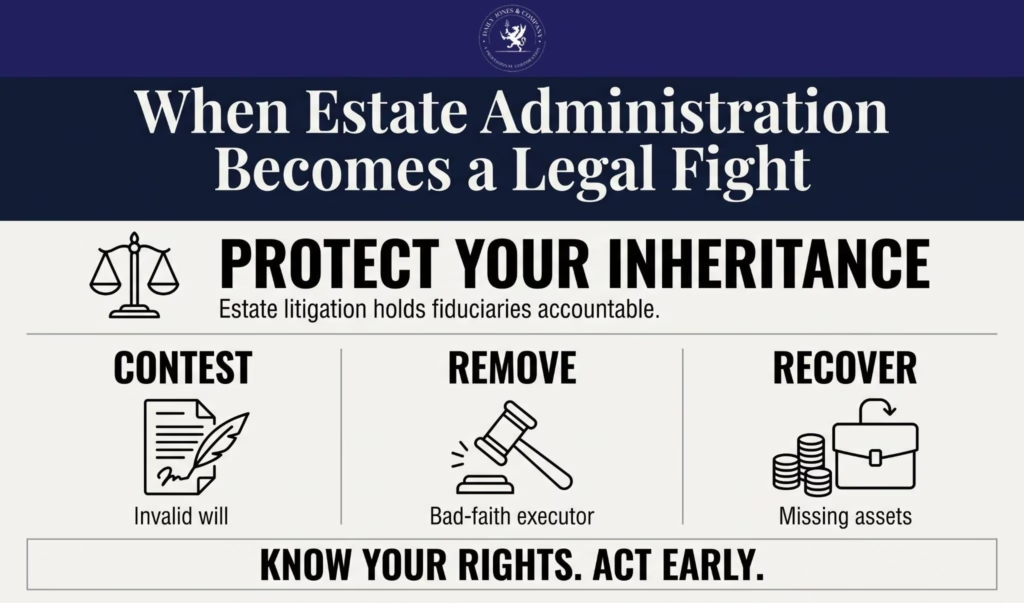
Common Estate Litigation Matters
Will Contests
Under California Probate Code § 8270, interested parties have 120 days from the date a will is admitted to probate to formally contest it. Recognized grounds include lack of testamentary capacity, undue influence, fraud, forgery, duress, and improper execution. That deadline is short and unforgiving. If a will has already been admitted, the calendar is the first thing to check.
Executor Misconduct and Removal
Executors must act in the estate’s interest, not their own. The American College of Trust and Estate Counsel identifies their duties as collecting and protecting assets, paying debts, filing accountings, and distributing property according to the will. Failure on any of these fronts supports removal under California Probate Code § 8500 and personal liability for resulting losses.
Watch for one tell in particular: the fiduciary paying their personal legal fees out of estate funds. In the Rosenblatt matter, the fiduciary borrowed $200,000 against property she was supposed to protect and spent it on lawyers to stop the owner from removing her. The court called it self-dealing and counted every dollar.
Recovery of Estate Property
California Probate Code § 850 lets an interested party petition for recovery of property wrongfully transferred or concealed before or after death. People underuse it because they assume the money is gone. It usually isn’t.
What § 850 Actually Did in Rosenblatt
In Amendment & Complete Restatement of the Arnold Rosenblatt Revocable Living Trust, Los Angeles Superior Court Case No. 20STPB03748, $746,147.78 in trust funds went to a house the fiduciary titled in her own name and paid nothing for. Her accounting called it a gift. The court: “no independent testimony nor any documents to verify this claim of a substantial gift.” Title was ordered back, free and clear.
A gift an attorney-in-fact makes to himself outside the scope of the power is void even under the principal’s express oral direction (Estate of Huston (1997) 51 Cal.App.4th 1721, 1727). “He told me I could have it” is not the end of the conversation.
Elder Financial Abuse in Estate Disputes
Estate litigation overlaps constantly with elder financial exploitation. California’s elder abuse statutes carry remedies unavailable in ordinary probate: double damages under Probate Code § 859, mandatory attorney’s fees, and treble damages under Penal Code § 496(c). In Rosenblatt, that overlay turned $2,709,779.27 in compensatory damages into a judgment of $22,911,759.35. If the person you are dealing with took from someone 65 or older, plead it.
Signs an Executor May Be Breaching Their Duties
Misconduct arrives as a pattern:
- Distributions delayed indefinitely without explanation
- Refusal to provide inventories or accountings
- Estate property sold below market value to connected parties
- Estate funds paying the fiduciary’s personal legal fees
- You cannot see the accounts — no statements, no access, no visibility
In Rosenblatt, the trust’s brokerage accounts were opened in the fiduciary’s name. The owner was not a signatory and received no statements for roughly seven years. As California Courts’ probate self-help resources explain, beneficiaries have the right to petition the court when an executor fails to perform. That right does not enforce itself.
What Evidence Supports Estate Litigation
The strength of an estate case is almost always an evidence question. The foundation is the will and codicils, estate inventories and accountings, bank records, deeds, medical records near the time of execution, and communications between the fiduciary and beneficiaries.
Two categories get consistently overlooked. Loan applications: people tell lenders things they will not tell a court. And the fiduciary’s own filings compared against each other: in Rosenblatt, her accounting reported $471,823.21 in transfers to her nonprofit, her later petition reported $384,944, and her CPA testified the tax filings showed roughly $125,000. Three numbers, one set of books. Keep the voicemail too — in Rosenblatt, a transcribed voicemail said everything a court needed to hear.
How Estate Litigation Proceeds
Filing, Discovery, and Experts
Estate litigation begins with a petition in the probate division of the California Superior Court. Discovery follows: subpoenas, depositions, and expert disclosures. Where capacity or undue influence is contested, expect experts on both sides. In Rosenblatt the court credited a geriatric psychiatrist whose testimony “withstood vigorous cross-examination” and discounted the opposing expert who “exceeded the bounds of an expert witness and became an advocate.” Experts do not cancel each other out. Many disputes resolve at mediation — cases that proceed are decided by a probate judge, not a jury.
What Courts Can Order
Removal of the executor, a compelled accounting, voiding of unauthorized transfers under § 850, a constructive trust, expungement of fraudulent liens, surcharge, injunctions, double and treble damages, attorney’s fees, and a permanent bar against the wrongdoer. In Rosenblatt the court granted nearly all of it: a judgment of $22,911,759.35 including $6,576,447.74 in attorney’s fees. It found the trustee guilty of “oppression, fraud, and malice” but awarded no punitive damages because the record lacked proof of her net worth. You get what you prove.
The Timing That Matters
The Rosenblatt petition was filed May 12, 2020. Judgment entered December 30, 2024. The accounting order landed in July 2021 — the document that won the case existed three years before the case ended. Early petitions lock the other side into numbers before anyone knows which ones will matter.
The Attorneys Who Handle These Cases
James D. Daily, Esq.
James Daily has spent more than 30 years litigating estate disputes, will contests, executor misconduct claims, and fiduciary abuse matters across California and internationally. He tried the Rosenblatt matter to judgment and argued the Penal Code § 496(c) claim that produced the treble damages award.
Michael Jones, Esq.
Michael Jones focuses on fraud, theft, and breach of fiduciary duty, with a decade of experience in state and federal courts. He was co-counsel of record in the Rosenblatt trial. His background includes working alongside the FBI, U.S. Marshals, and district attorney offices on financial misconduct cases. At Daily Jones and Company, he handles will contests, executor disputes, and fiduciary abuse claims with a results-driven approach.
Alexandra Jarvis, Esq.
Alexandra Jarvis brings trial litigation experience and sophisticated real estate expertise to the firm’s estate litigation practice. Before joining Daily Jones and Company, she practiced business litigation at Call and Jensen and represented luxury real estate clients across Orange County. Her focus includes estate disputes involving real property, undue influence, financial elder abuse, and fiduciary misconduct. She earned her J.D., with distinction, from UC Irvine School of Law and has been admitted to practice in California since 2019.
Contact The Daily Jones and Company
An estate dispute does not resolve in your favor on its own. The § 8270 window for contesting a will admitted to probate is 120 days, not a year. Arnold Rosenblatt got his house back, his title cleared, and a judgment for more than $22.9 million — not because the other side came around, but because a petition was filed and a judge was asked to look.
That is the only part of this you control. Contact the firm for a free consultation.
Frequently Asked Questions
What is estate litigation?
Estate litigation is court-based dispute resolution over wills, estates, executors, beneficiaries, and estate assets. It arises when routine probate breaks down over a contested will, executor misconduct, missing assets, or a beneficiary’s rights being ignored. It is heard in the probate division of the California Superior Court.
Can beneficiaries sue an executor in California?
Yes. Under California Probate Code § 8500, interested parties can petition to remove an executor for misconduct, failure to account, self-dealing, or failure to administer the estate properly. Courts can also order surcharge damages requiring the executor to personally restore losses.
What is California Probate Code § 850 and when does it apply?
Section 850 allows petition for recovery of property wrongfully transferred or concealed before or after death. In Rosenblatt, a § 850 cross-petition recovered title to a house purchased with $746,147.78 in trust funds, expunged a fraudulent lis pendens on the elderly owner’s residence, and supported a judgment exceeding $22.9 million.
What if someone has recorded a claim against estate property?
A lis pendens clouds title and can freeze a sale while a dispute drags on. In Rosenblatt, the fiduciary recorded one asserting an expected inheritance against the residence. The court expunged it, declared her claims void, and permanently barred her from asserting any interest in the property.
How much can be recovered in an estate dispute involving an elder?
Probate Code § 859 doubles compensatory damages. Penal Code § 496(c) trebles them. Both carry attorney’s fees. In Rosenblatt, $2,709,779.27 produced a total judgment of $22,911,759.35. A judgment is not a collection — recovery depends on what can be traced and reached.
How is estate litigation different from probate?
Probate is the court-supervised administration of an estate. Estate litigation arises when a dispute inside that process needs judicial resolution. Not every probate involves litigation, but litigation always involves the probate court.
How long does estate litigation typically take?
Mediated disputes can conclude in months. Contested cases typically take one to three years. The Rosenblatt case took more than four and a half years. Acting promptly preserves evidence and legal options.