

When their parents divorced, four children got a promise in writing. The marital settlement agreement protected their share. Their father remarried, built twenty more years of estate planning on top of that original promise, and then died. A new will appeared, disregarding all of it. His widow took control of every account and refused to pay the children the share their parents’ agreement had guaranteed them.
Four adult children, holding a signed contract, told they were entitled to nothing. They were wrong. The case ran across Orange County and San Bernardino Superior Courts and ended in a $57 million arbitration award. A later document does not automatically erase an earlier obligation. That is the whole fight, and it is worth having. The Daily Jones and Company is at 660 Newport Center Drive in Newport Beach, minutes from the Orange County Superior Court Probate Division. Contact the firm for a free consultation.

Estate Litigation vs. Probate Administration
Most estates move through probate without a dispute. Estate litigation begins when that breaks down: a fiduciary acting in bad faith, a will’s validity in question, or a beneficiary’s rights ignored.
| Probate Administration | Estate Litigation | |
| Nature | Routine estate process | Legal dispute |
| Contested | Usually no | Yes |
| Who decides | Executor administers | Court resolves |
| Focus | Asset distribution | Rights and accountability |
Beneficiaries routinely read early warning signs as administrative delay. They are usually looking at a legal violation, and the misreading costs them time, evidence, and leverage.
Why Estate Disputes Are Common in Orange County
Orange County’s concentration of high-value real estate, family businesses, and multigenerational wealth produces estate disputes with regularity. Blended families pit children from a prior marriage against a surviving spouse. Closely held business interests are hard to value and harder to divide. Late-life estate plan changes raise undue influence concerns.
As the California Attorney General’s elder abuse resources document, financial exploitation surfaces constantly in these disputes, particularly when a new will appears shortly before death following caregiver isolation or cognitive decline.
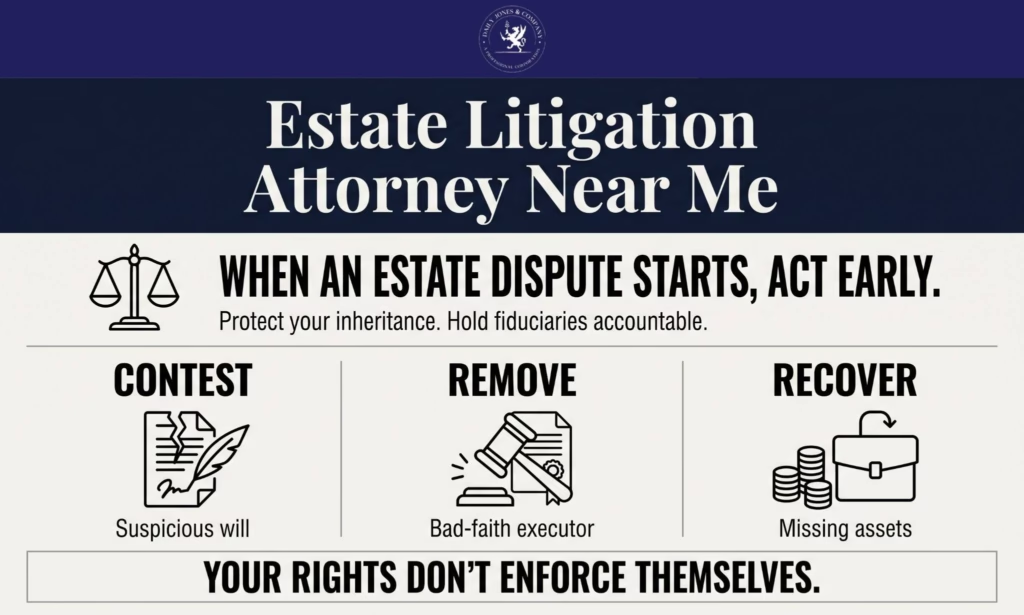
Common Estate Litigation Matters in Orange County
Will Contests
Under California Probate Code § 8270, interested parties have 120 days from the date a will is admitted to probate to contest it. Missing that deadline generally bars the challenge permanently. If a will has already been admitted, the calendar is the first thing to check.
Executor Misconduct and Removal
The American College of Trust and Estate Counsel identifies executor duties as collecting and protecting estate assets, providing accountings, paying valid debts, and distributing property according to the will. An executor who delays distributions, refuses to account, self-deals, or favors one beneficiary can be removed under California Probate Code § 8500 and held personally liable for resulting losses.
One tell shows up in almost every matter: the fiduciary paying personal legal fees out of estate funds. In a Los Angeles trust case the firm tried to judgment, a fiduciary borrowed $200,000 against property she was supposed to protect and spent it on lawyers to stop the owner from removing her. The court called it self-dealing and counted every dollar.
Recovery of Estate Property
California Probate Code § 850 lets an interested party petition for recovery of property wrongfully transferred or concealed before or after death. Families underuse it because they assume the money is gone. It usually isn’t — it is usually sitting in a house, a title, or an account in someone else’s name.
One rule answers the defense you will hear in nearly every pre-death transfer case: a gift an attorney-in-fact makes to himself, outside the scope of the power of attorney, is void even under the principal’s express oral direction (Estate of Huston (1997) 51 Cal.App.4th 1721, 1727). “He told me I could have it” is not the end of the conversation.
Elder Financial Abuse in Estate Disputes
Estate litigation overlaps constantly with elder financial exploitation. California’s elder abuse statutes carry remedies unavailable in ordinary probate: double damages under Probate Code § 859, mandatory attorney’s fees, and treble damages under Penal Code § 496(c) where the conduct amounts to receiving or withholding stolen property. If the person on the other side took from someone 65 or older, plead it — it is often the difference between recovering a fraction and making the taking unprofitable.
Signs an Executor May Be Breaching Their Duties
Misconduct arrives as a pattern:
- Distributions delayed indefinitely without explanation
- Refusal to provide inventories or accountings
- Estate property sold below market value to connected parties
- Estate funds paying the fiduciary’s personal legal fees
- You cannot see the accounts — no statements, no access, no visibility
That last one is the condition the rest grow inside. Self-dealing is easy when nobody can read the ledger. As California Courts’ probate self-help resources explain, beneficiaries have the right to petition the court when an executor fails to perform. That right does not enforce itself.
How Estate Litigation Proceeds in Orange County
Filing and the Litigation Track
Estate litigation is filed in the Orange County Superior Court Probate Division. It begins with a petition setting out the petitioner’s standing, the relief sought, and the legal basis for the claim. Discovery follows, and in most cases a mediation phase before any hearing. Many disputes settle before trial. Cases that proceed are decided by a probate judge, not a jury.
Courts can order removal of the executor, a compelled accounting, voiding of unauthorized transfers under § 850, a constructive trust, expungement of fraudulent liens, surcharge, injunctions, double and treble damages, and attorney’s fees.
How Long It Takes
Mediated disputes can conclude in months. Contested cases typically take one to three years. The firm’s Los Angeles trust matter took four and a half years from petition to judgment, but an accounting order obtained three years before the case ended was the document that won it. Early petitions lock the other side into numbers before anyone knows which ones will matter.
Results
A $57 Million Result in Orange County
James Daily litigated the blended family matter across Orange County and San Bernardino Superior Courts, securing a $57 million arbitration award along with recovery of trust assets, a vacation property, and bank restitution. A promise made in a marital settlement agreement is a contract. A will written twenty years later does not quietly repeal it.
A $22.9 Million Judgment in Los Angeles County
In Amendment & Complete Restatement of the Arnold Rosenblatt Revocable Living Trust, Case No. 20STPB03748, a 97-year-old man’s attorney-in-fact had taken more than $2 million: a house bought with $746,147.78 of his money, nine years of uncollected rent on a trust-owned building, a $200,000 loan spent on her own lawyers, and a fraudulent lis pendens on his residence of thirty years. The court found for him on every cause of action, ordered the house returned, expunged the lis pendens, and barred her from ever profiting from the trust.
Judgment entered December 30, 2024 at $22,911,759.35, including $6,576,447.74 in attorney’s fees. It found her guilty of “oppression, fraud, and malice” but awarded no punitive damages because the record lacked proof of her net worth. You get what you prove.
Prior results do not guarantee a similar outcome.
The Attorneys Who Handle These Cases
James D. Daily, Esq.
James Daily has spent more than 30 years litigating estate disputes, will contests, executor misconduct claims, and fiduciary abuse matters in Orange County and throughout California. He secured the $57 million blended family award and tried the Rosenblatt matter to judgment.
Michael Jones, Esq.
Michael Jones focuses on fraud, theft, and breach of fiduciary duty, with a decade of experience in state and federal courts. He was co-counsel of record in the Rosenblatt trial. His background includes working alongside the FBI, U.S. Marshals, and district attorney offices. At Daily Jones and Company, he handles will contests, executor disputes, and fiduciary abuse claims with a results-driven approach.
Alexandra Jarvis, Esq.
Alexandra Jarvis brings trial litigation experience and sophisticated Orange County real estate expertise to the firm’s estate litigation practice. Before joining Daily Jones and Company, she practiced business litigation at Call and Jensen and represented luxury real estate clients across Orange County, closing approximately $40 million in sales in her first year. Her focus includes estate disputes involving real property, undue influence, financial elder abuse, and fiduciary misconduct. She earned her J.D., with distinction, from UC Irvine School of Law and has been admitted to practice in California since 2019.
Contact The Daily Jones and Company
The § 8270 window for contesting a will admitted to probate is 120 days, not a year, not “when things calm down.” Four adult children were told a piece of paper had erased their father’s promise. It hadn’t. They had to ask. That is the only part of this you control.
Contact the firm for a free consultation. The Daily Jones and Company handles estate litigation throughout Orange County — will contests, executor removal, asset recovery, and complex fiduciary abuse claims.
Frequently Asked Questions
When should I hire an estate litigation attorney in Orange County?
As soon as something feels wrong. Evidence deteriorates, assets move, and California probate deadlines are strict.
Can a will be challenged after probate begins in California?
Yes. Under California Probate Code § 8270, interested parties have 120 days from the date the will is admitted to probate to file a formal contest. Missing that deadline generally bars the challenge permanently.
What if a new will contradicts a marital settlement agreement?
A later will does not automatically override an earlier contractual obligation. Where a marital settlement agreement commits a person to leave specific property to specific people, those beneficiaries may have contract rights that survive a contradicting will. In the firm’s blended family matter, four adult children recovered a $57 million arbitration award on exactly that basis.
Can an executor be removed in Orange County?
Yes. Under California Probate Code § 8500, an interested party can petition to remove a personal representative for breach of fiduciary duty, self-dealing, failure to account, or misappropriation. Removal does not require waiting for a final judgment.
What happens if estate assets were transferred before death?
California Probate Code § 850 allows petition for recovery of property wrongfully transferred or concealed before or after death. In the firm’s Los Angeles trust matter, a § 850 petition recovered title to a house purchased with $746,147.78 of the victim’s money, expunged a fraudulent lis pendens on his residence, and supported a judgment exceeding $22.9 million.
How much can be recovered in an estate dispute involving an elder?
Compensatory damages restore the loss. Probate Code § 859 doubles it. Penal Code § 496(c) trebles it. Both carry attorney’s fees. In the Rosenblatt matter, $2,709,779.27 produced a total judgment of $22,911,759.35. A judgment is not a collection; orders returning specific property often matter more than the headline figure.
How long does estate litigation typically take?
Mediated disputes can conclude in months. Contested cases typically take one to three years. The firm’s Los Angeles trust matter took more than four and a half years. Acting promptly preserves evidence and keeps the timeline manageable.