

There is no single dollar figure that tells you whether an estate requires formal California probate. The real question is which assets actually belong in the calculation, how each one is titled, and whether one of California’s several simplified procedures applies instead.
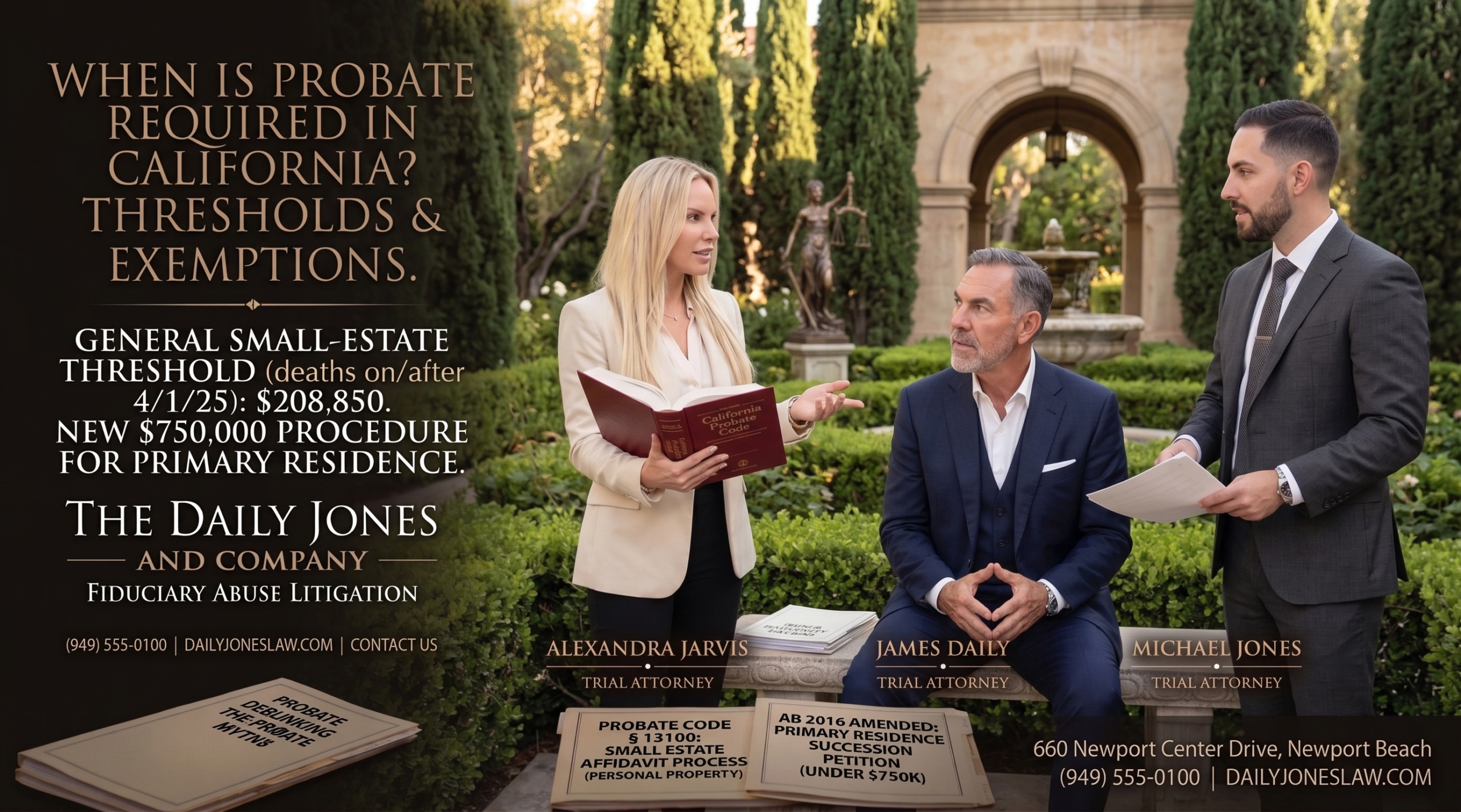
For deaths on or after April 1, 2025, the general small-estate threshold under Probate Code §§ 13100–13101 is $208,850, up from $184,500. But that number answers a narrower question than most people think it does. Contact The Daily Jones and Company to review what a specific estate actually requires.
The Threshold Depends on When the Person Died
| Date of Death | § 13100 General Threshold |
| Before April 1, 2022 | $166,250 |
| April 1, 2022 – March 31, 2025 | $184,500 |
| On or after April 1, 2025 | $208,850 |
Probate Code § 890 requires the Judicial Council to adjust these figures on a roughly three-year cycle, most recently effective April 1, 2025, with the next adjustment scheduled for April 1, 2028.
$208,850 Is Not the Person’s Net Worth
This is the biggest misconception. Someone can die owning assets worth well over $208,850 and still avoid formal probate for most of them, because the threshold only counts property that would otherwise pass through probate in the first place.
Probate Code § 13050 excludes property held in a living trust, joint tenancy property, assets passing to a surviving spouse, accounts with named beneficiaries, and several other categories entirely from the calculation. The right question isn’t “what was the estate worth.” It’s “what did the person own, how was each asset titled, and did it already have a transfer mechanism outside probate.”
The California Courts self-help guide also confirms the calculation uses gross value, not net equity. Debts and mortgages are not simply subtracted to get an estate under the line.
Major 2025 Change: A $750,000 Procedure for a Primary Residence
The single biggest shift in this area is Probate Code §§ 13151–13154, amended by AB 2016, which lets a successor petition the court to determine succession to a decedent’s California primary residence where the gross value doesn’t exceed $750,000, up sharply from the prior $184,500 figure. A house worth $600,000 no longer automatically means formal administration. The petition can be filed 40 days after death, though eligibility and actual timing are separate questions; the process still runs through the probate court, unlike the affidavit-only small-estate procedure.
Is California’s general probate threshold now $750,000? No. The $750,000 figure applies specifically to a qualifying primary residence under §§ 13151–13154. The general small-estate limit for other property is still $208,850 under § 13100. Conflating the two is the most common error in older content on this topic.
California Also Has a Small-Value Real Property Procedure
Probate Code § 13200 allows a separate affidavit procedure for California real property, distinct from a primary residence, where the gross value doesn’t exceed $69,625 for deaths on or after April 1, 2025. Between the § 13100 affidavit, the § 13151 primary-residence petition, and the § 13200 small-value real property affidavit, California effectively runs three different thresholds depending on what’s being transferred, not one.
What Keeps Property Out of Probate Entirely
Living trusts. Property properly funded into a trust generally passes under the trust terms without probate for that asset. The word that matters is “funded.” A signed trust that never received the deed to the house doesn’t keep that house out of probate.
Joint tenancy and survivorship. The California Courts guidance on estate property confirms that jointly held property with right of survivorship passes to the surviving owner directly. The title has to actually say joint tenancy, not tenants in common or sole ownership, for this to apply.
Payable-on-death and transfer-on-death accounts. A bank or brokerage account with a valid POD or TOD beneficiary passes to that person directly, provided the beneficiary is alive at death and the designation actually covers the account in question.
Transfer-on-death deeds. California permits a TOD deed for qualifying real property, letting it pass to a named beneficiary without probate administration for that parcel specifically.
Having a will does not do this. California Courts is explicit that an estate may still require probate even where a valid will exists. A will names who inherits and who administers; it does not convert a solely owned asset into a nonprobate one.
Why the Same Dollar Figure Can Produce Different Outcomes
A $700,000 estate is not one answer. A $700,000 home held entirely in a properly funded trust generally avoids formal probate for that asset. The same $700,000 home, solely owned with no trust, no joint tenancy, and no TOD deed, may qualify for the § 13151 primary-residence petition instead of full administration. A $700,000 brokerage account with a valid TOD beneficiary transfers directly. A $700,000 solely owned account with no beneficiary designation and no other transfer mechanism is where formal probate typically becomes necessary.
Ownership structure, not the number on the account statement, drives the outcome.
The Practical Framework
Identify every asset, then check three things for each one: how it’s titled, whether it carries a beneficiary or survivorship designation, and its date-of-death value under the applicable statutory valuation, not today’s market estimate or the number from a tax bill. Only after that asset-by-asset review does it make sense to ask which of California’s procedures, if any, applies to what remains.
When Formal Probate Actually Becomes Necessary
Formal administration is generally required when solely owned property exceeds the applicable simplified-procedure threshold and carries no trust funding, survivorship right, or beneficiary designation. It also becomes necessary when a dispute arises: a contested will, a fiduciary who won’t account, or family disagreement over how ambiguous language should be read.
Probate itself is not a catastrophe for a straightforward estate. It is a predictable, court-supervised process. The real risk most families face is the opposite one: a trust that was signed but never funded, which sends the family into probate anyway despite the planning they paid for.
The Attorneys Who Handle These Matters
James D. Daily, Esq. has more than 30 years of experience litigating probate and trust matters throughout California, and has seen firsthand how an unfunded trust or an ambiguous transfer structure turns into years of family litigation. His planning guidance is shaped directly by that litigation experience.
Michael Jones, Esq. focuses on fraud, theft, and breach of fiduciary duty, with a decade of state and federal court experience that informs how estates involving contested asset transfers get evaluated early.
Alexandra Jarvis, Esq. brings real estate transactional expertise to matters involving a primary residence, TOD deeds, and jointly held property, where title structure often determines the outcome. She earned her J.D., with distinction, from UC Irvine School of Law and has practiced in California since 2019.
Contact The Daily Jones and Company
Whether an estate requires formal probate depends on facts most families haven’t organized yet: what was owned, how it was titled, and whether a transfer mechanism was already in place. Contact the firm or explore trust and estate planning to get a clear answer before assuming either extreme.
Frequently Asked Questions
Is California’s probate threshold $208,850 or $750,000?
Both figures are current, but they govern different procedures. $208,850 applies to the general small-estate affidavit under § 13100 for personal property. $750,000 applies only to the newer petition procedure for a decedent’s qualifying California primary residence under §§ 13151–13154.
Does having a will mean an estate skips probate?
No. A will controls who inherits and who can serve as personal representative, but it doesn’t change how an individually owned asset is classified. Probate may still be required for solely owned property regardless of whether a valid will exists.
Can I subtract the decedent’s debts to get an estate under the threshold?
No. The threshold calculation uses gross value, not net equity. A $250,000 account with $100,000 in associated debt is still valued at $250,000 for these purposes, not $150,000.
If most assets are in a trust, does a stray bank account still require probate?
It depends on that account’s own value and titling, evaluated on its own, not against the trust’s total value. A modest solely owned account may qualify for the § 13100 affidavit even where the bulk of the estate passed outside probate through the trust.
Does jointly owned property automatically avoid probate?
Only if the title actually reflects joint tenancy or community property with right of survivorship. Property held as tenants in common does not carry that survivorship right and may still require probate for the deceased owner’s share.
What value should I use for a house, the purchase price, the tax assessment, or today’s market value?
None of those automatically. Eligibility for these procedures depends on the statutory valuation applicable to the specific procedure, generally requiring a probate referee appraisal rather than a self-estimated figure.
Will the $208,850 threshold change again soon?
The Judicial Council adjusts these figures on a periodic cycle under Probate Code § 890, historically about every three years. Confirm the current figure against the Judicial Council’s published schedule before relying on any number, including this one, for a specific filing.