

A business partner diverted company funds into a personal account. A trustee sold trust property to themselves at a price they set. An attorney-in-fact made gifts to themselves the principal never authorized. California law treats what happened as more than a breach of contract. It treats it as a betrayal, and the remedies reflect that.
California breach of fiduciary duty claims carry some of the most powerful remedies in civil litigation: compensatory damages, disgorgement of profits whether or not you lost anything, constructive trusts on specific property, punitive damages, and in trust cases, double damages under Probate Code § 859. Contact The Daily Jones and Company for a free consultation.
What Makes a Fiduciary Relationship
California law recognizes both formal and informal fiduciary relationships. Formal ones arise by operation of law: trustees, executors, corporate officers, attorneys, agents under a power of attorney, and licensed real estate agents all owe fiduciary duties as a matter of law. Informal ones arise where one party places trust and confidence in another’s integrity and the other accepts it, recognized between business partners, joint venturers, and financial advisers. Controlling shareholders owe the same duty to minority stockholders under Jones v. H. F. Ahmanson & Co. (1969) 1 Cal.3d 93, which holds that majority control cannot be used to benefit the majority alone.
California Civil Jury Instructions (CACI No. 4100) define the relationship as one where a party “is in duty bound to act with the utmost good faith for the benefit of the other party.”
The Four Elements and the Burden-Flip
CACI No. 4100 requires a plaintiff to prove: a fiduciary relationship existed, the defendant breached that duty, the breach caused harm, and the plaintiff suffered damages. The standard depends on the relationship. Trustees must act as a prudent person would under Probate Code § 16047. Corporate officers owe duties of care and loyalty. Attorneys are held to the standard of a reasonably competent attorney.
What a Breach Can Look Like
| Fiduciary | Potential Breach |
| Trustee | Buying trust property below market value personally |
| Business partner | Diverting a company opportunity to another business they own |
| POA agent | Making unauthorized gifts to themselves |
| Corporate officer | Using confidential company information for personal gain |
| Executor | Using estate property for personal purposes |
Once a plaintiff shows a fiduciary obtained a benefit from a transaction with the beneficiary, the burden shifts to the fiduciary to prove the transaction was fair (Buchmayer v. Buchmayer (1945) 68 Cal.App.2d 462, 467). Where a fiduciary dealt with trust property in an individual capacity, courts “will not permit any investigation into the fairness of a transaction” at all (In re Boggs’ Estate (1942) 19 Cal.2d 324, 333). The plaintiff does not have to prove unfairness. The fiduciary has to prove fairness.
Remedies Available in a Fiduciary Breach Case
Compensatory Damages and Disgorgement
Compensatory damages restore the plaintiff to the position they’d have been in had the fiduciary performed properly. Under Civil Code § 3333, this includes actual losses, proximately caused harm, and lost profits proven with reasonable certainty.
Disgorgement forces the fiduciary to forfeit profits made through the breach, even without a corresponding loss to the plaintiff. In trust litigation, Probate Code § 16440 offers three measures, calculated independently, with courts applying whichever produces the greater recovery.
The same principle reaches business partners: under Corporations Code § 16404, a partner who diverts a company opportunity to a business they personally own must disgorge that profit even if the partnership itself never lost money.
Double and Treble Damages
Probate Code § 859 can impose liability for twice the value of property recovered. The required showing depends on the theory: the elder and dependent adult financial abuse category doesn’t require a separate bad-faith finding, as Keading v. Keading (2021) 60 Cal.App.5th 1115 confirmed. Many § 859 claims start as a Probate Code § 17200 petition, the general mechanism for compelling an accounting, before the penalty claim gets layered on top once the numbers are clear. In Rosenblatt, § 859 doubled a compensatory award of $1,792,756.06 to $3,585,512.12 for one defendant alone.
Penal Code § 496(c) provides three times actual damages plus mandatory attorney’s fees when a fiduciary received, concealed, or withheld property they knew was obtained through theft or fraud. Penal Code § 484(a) defines theft broadly enough to include a consensual but fraudulent acquisition, making § 496(c) apply well beyond trust cases, business partnership fraud included. In Rosenblatt, § 496(c) added more than $8 million on top of the § 859 double damages.
Punitive Damages and Equitable Relief
Civil Code § 3294 permits punitive damages for fraud, malice, or oppression, proven by clear and convincing evidence. That finding doesn’t automatically produce an award; Rosenblatt’s court found oppression, fraud, and malice and still declined punitives for lack of net-worth evidence. The prayer matters. The proof matters more.
Courts can also order constructive trusts, injunctions, compelled accountings, rescission, and, in trust cases, removal under Probate Code § 15642. When property is actively at risk of transfer or dissipation, that relief can be sought on an emergency basis rather than waiting for trial. Recovering real estate is sometimes worth more than a judgment the debtor can’t pay.
How the Remedy Framework Differs by Relationship Type
The same conduct triggers different remedy frameworks depending on who the fiduciary is, which affects the available remedies, the burden of proof, and whether fees can be recovered.
| Fiduciary Type | Key Statute |
| Trustee | Prob. Code §§ 16400, 16420, 16440, 859 |
| Executor / administrator | Prob. Code §§ 8500, 859 |
| Corporate officer / director | Corp. Code §§ 309, 316 |
| Attorney | CACI 4106 |
| Agent under POA | Prob. Code §§ 4264, 4232 |
| Business partner | Corp. Code § 16404 |
Trust and probate matters generally fall under Fiduciary Abuse, Probate, and Trust Litigation; disputes between co-owners fall under Partnership Disputes; claims against officers or controlling shareholders sit within Corporate Law or Business Law.
What Evidence Actually Wins These Cases
Fiduciary breach cases are won on documents, not testimony: bank statements and wire records showing what moved and to whom; the fiduciary’s own filings compared for inconsistencies; loan documents, because people tell lenders things they won’t tell a court; and prior estate plans showing how dramatically things changed.
In corporate and partnership disputes, the decisive documents are often governance records rather than bank statements: board minutes and resolutions checked against their own file metadata for when they were actually created. A resolution purportedly signed before a disputed transaction but generated weeks later can be the single most decisive piece of evidence in the case.
In Rosenblatt, the defendant’s accounting, her later petition, and her CPA’s tax filings gave three different numbers for the same transfers. No expert testimony canceled that out.
Statute of Limitations
Code of Civil Procedure § 343 sets a four-year period for breach of fiduciary duty claims. Constructive fraud runs three years under CCP § 338(d). California applies the discovery rule: the period runs from when the breach was discovered, or reasonably should have been. Where a fiduciary concealed the breach, common in self-dealing, the period may be tolled.
The label placed on the claim doesn’t control the deadline. Courts look at the gravamen, the actual nature, of the claim, so related claims from the same conduct may carry different limitations periods. Do not treat four years as permission to wait.
The Attorneys Who Handle These Cases
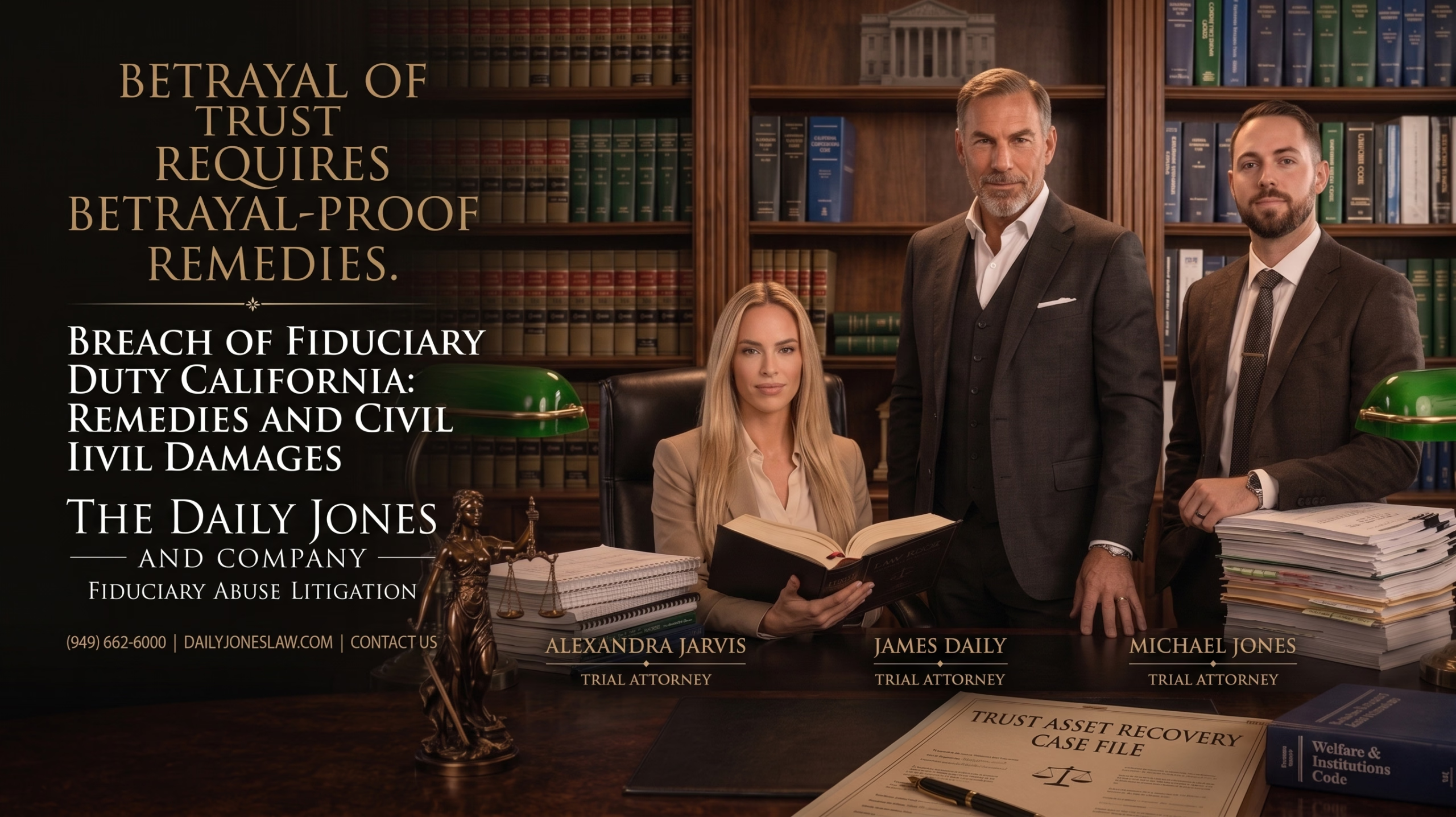
James D. Daily, Esq. has spent more than 30 years litigating fiduciary abuse, trustee misconduct, and complex civil fraud cases across California and internationally, including matters combining Probate Code surcharge, § 859 double damages, and § 496(c) treble damages.
Michael Jones, Esq. focuses on fraud, theft, and breach of fiduciary duty, with a decade of state and federal court experience, including work alongside the FBI, U.S. Marshals, and district attorney offices, which shapes how he builds evidence and constructs remedy arguments.
Alexandra Jarvis, Esq. covers fiduciary disputes intersecting with real property, business relationships, and complex estate structures. Before joining the firm, she practiced business litigation at Call and Jensen. She earned her J.D., with distinction, from UC Irvine School of Law and has practiced in California since 2019.
Contact The Daily Jones and Company
Fiduciary breach cases are won on early action and documentary evidence. The longer the breach continues, the more property moves and the harder recovery becomes. Contact the firm for a free consultation.
Frequently Asked Questions
What is the difference between breach of fiduciary duty and breach of contract?
A fiduciary relationship imposes a higher duty than a contract alone. Fiduciary breach requires showing the fiduciary acted against the principal’s interests, and California courts put the burden of proving fairness on the fiduciary. Disgorgement, constructive trust, and punitive damages are available in fiduciary cases and generally aren’t in contract cases.
Does disgorgement work the same way for business partners as trustees?
The principle is the same, but the statute differs. A partner who routes a company opportunity into a separate business they personally own owes that profit back under Corporations Code § 16404’s duty of loyalty, regardless of whether the partnership itself lost anything. Same forfeiture logic, applied through the partnership statute instead of the probate code.
Is Penal Code § 496(c) only available in trust and elder abuse cases?
No. Because Penal Code § 484(a) defines theft broadly enough to cover a fraudulent acquisition that looked consensual on paper, § 496(c)’s treble damages and mandatory fees reach business partner and corporate fraud just as readily as trust misconduct, and it’s frequently underused there.
Can a minority shareholder sue a controlling shareholder directly?
It depends on whether the harm was individual or to the corporation as a whole. Under Jones v. H. F. Ahmanson & Co., a shareholder can bring an individual claim when the injury wasn’t merely incidental to harm suffered by the corporation generally; otherwise it typically has to proceed as a derivative action.
How long do I have to file a breach of fiduciary duty claim?
Generally four years under CCP § 343, subject to the discovery rule, or three years for constructive fraud under § 338(d). Because the deadline follows the gravamen of the claim, a matter that also involves elder financial abuse can carry the separate four-year clock under Welfare and Institutions Code § 15657.7.
Does breach of fiduciary duty have to go to trial?
No. Many cases resolve through mediation, particularly when one side holds substantially stronger documentary evidence. Courts can also grant interim relief, including freezing assets and compelling accountings, before final resolution.